This article was written 8 years ago how far do you think Decathlon have come and what is different now. Comment below and see what people think?
I have a confession. I’ve become obsessed with the business model of Decathlon. I’ve found myself being drawn to their stores -getting lost in their various “departments” being drawn to their “brands”.
Its a huge mindset shift for me. It is also one that, I believe, is being reflected in the minds of many UK consumers. Their attitude towards this French import is also changing.




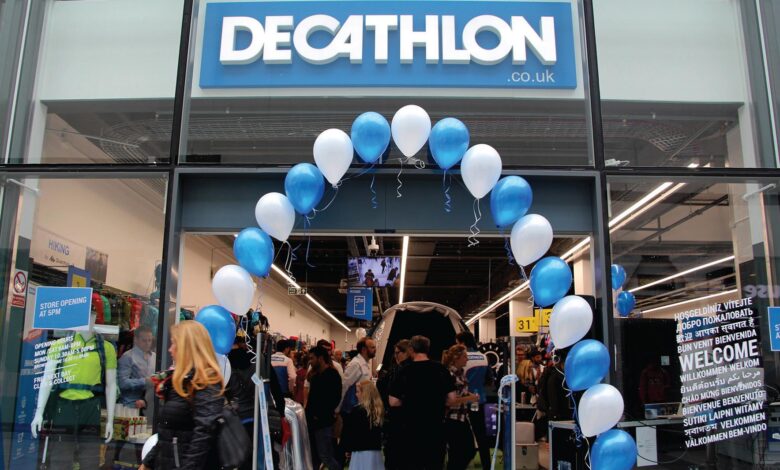
I remember vividly when the retailer first opened its doors in the UK back in 1999 in Surrey Quays. There was 45,000 sqft of impressive retail space. Much of it, as is the companies core strategy, focussed around the Decathlon Group own brands rather than the traditional sports brands. These were the brands that we had come to recognise around that time.
I remember because, both as a member of the sporting goods industry, and as a sportsman, I was slightly snobbish about this approach.
I think the trade attitude was very much that this model simply wouldn’t work with the UK consumer. After all, we had always demanded “authentic” brands. These were brands with heritage, a connection, and a marketing story. Remember this was a time when Nike and adidas where pushing aggressively into a market. Sporting goods were becoming street wear during this era.
This was a time when there was a core of regional and multiple sports retailers serving the consumer with global brands. The perception of many was that we simply wouldn’t have an appetite for these in house brands. Even though the product was very strong and offered value for money, many doubted the demand.
In fact this assumption seemed to be underlined. Sports Direct embarked on their aggressive brand acquisition strategy, giving us those very brands that we desired but at those prices that we demanded.
Roll forward to 2018, and that same Decathlon Surrey Quays store has just had a £14m revamp. It has doubled in size. The French retailer is now also the largest sporting goods retailer in the world.
Decathlon now has 43 stores in the UK with plans for future store openings already in the pipeline.
So whats changed? Is there a lesson in brand management that we can learn here?
Certainly few stores reveal as much about modern distribution as Decathlon. Its own brands play a key role in its growth. In one recent article, Anglo-Saxon academic research notes that the share of shelf space given over to own brands among US retailers is less than among European distributors (Crustiest al, 2006).
It is true that in the United States, for example, own retailer brands have a poor reputation, and are all considered ‘sub brands’. They do not allow for positioning of the store or the loyalty generation through attachment to the store. The situation is different in Europe and Canada. There, very early in their brand history, in house brands had a combative vocation: fighting not to launch a price war, but to offer the consumer genuine value.
This is the essence of the Decathlon approach.
Decathlon has become a designer of brands that controls its own distribution.
With over 20 brands and research and development facilities all over France to develop the latest designs, they continue to innovate. They have a dedicated product development and design team for each sporting category.
The Decathlon principle is clear – to reduce its main manufacturer brands and to develop its own brands. But this wasn’t originally the case.
In 1999 in France, after 23 years of uninterrupted growth, for the first time in its history its turnover per square metre fell. The diagnosis was simple: the policy of a single brand, Decathlon, strongly emphasised in all its stores, together with its dominance of the national market, created a monopolistic situation and a ‘Soviet-like’ brand. Whether on the beach, on the ski lift, while hiking in the forest, everyone wore Decathlon-branded products. As a result, customers increasingly got the impression of a lack of choice.
The response was to fundamentally abandon nearly 25 years of store brand policy, in France and abroad, and to move towards a portfolio of brands segmented by sport. In order to create these brands, it began with the observation that there were 60 sports under Decathlon’s roof.
For each brand to reach critical mass and justify its overheads, a shortlist of 17 was drawn up and combined into seven finally. Later, it was decided to increase this number, since modern sports are ‘group that cannot easily be brought under the same tent in the name of ‘critical mass” .
Thus, for example, Dionysus separated into roller sports and running. Tennis and golf have also separated. They had previously been united under the common brand Kinesis.
These brands then became autonomous, decentralized business units, with dedicated teams. The objective was to turn them not into labels on products, but forces for creative proposals at the best prices. Additionally, they hoped these brands would appeal to passionate people.
These business units and brands were then located close to where the sports are practiced, so that the internal teams can live them out. Local opinion leaders also play a role in their creation: Triode by the sea, Quench in the mountains. They communicate independently of one another.
Its a strategy that plays out effectively in an in-store environment that is spacious and uncluttered.
Departments are clearly identified in the same way. The brands associated with particular sports wrapped themselves around the proposition.
Its compelling. Inviting. The breadth of product appeals to the weekend warrior as much as it does to the serious athlete.
In 2017, the group announced an increase of its turnover by four per cent in like-for-like sales to 11 billion euro. Web sales only accounted for 4.5 per cent (up from 4.1%) but is a key area of focus for future development. Mainstream brands are being almost entirely phased out. This leaves the in-house brands to drive the business forward.
Its an evolution that appears more and more acceptable to the UK market. It is also the antithesis of the Sports Direct “Selfridges of Sport” strategy.
It remains to be seen how things will evolve in the future but, in the meantime, don’t be surprised if you find me lost in the Oxford store!